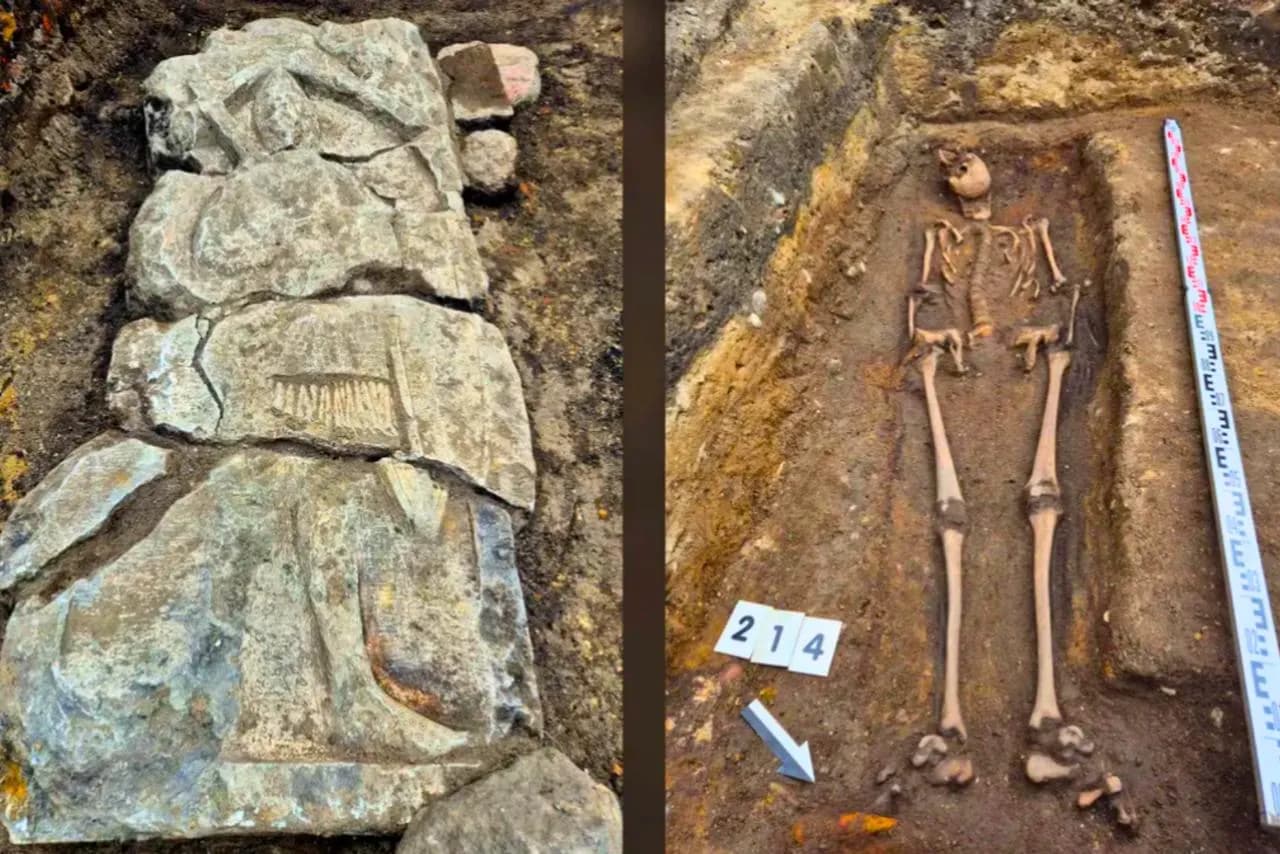
A Knight Surfaces in Downtown Gdańsk
In July 2025, archaeologists working in the historic center of Gdańsk made one of the most striking medieval finds in recent Polish history: a carved limestone tombstone covering the grave of a presumed knight, buried roughly 700 years ago. The site happened to sit beneath what had been a well-known ice cream shop, making the contrast between past and present all the more vivid.
The funerary slab measures 150 centimeters, just under five feet, and depicts a standing figure dressed in full chainmail armor and carrying a sword and shield. What makes the stone especially notable is its material: the limestone was quarried on the Swedish island of Gotland, a significant distance away. Importing stone of this quality across the Baltic signals that whoever commissioned the tomb had both wealth and connections.
What the Excavation Revealed
The ArcheoScan team, co-directed by archaeologist Sylwia Kurzyńska, was excavating a fortified site occupied between the 11th and 14th centuries. The complex once held a castle, a church, and a cemetery, a layout that reflects how military, religious, and civic life were intertwined in medieval urban centers.
Once the slab was carefully lifted, the team found a well-preserved male skeleton beneath it. No grave goods accompanied the remains, which is unusual given the elaborateness of the tombstone. Researchers note this could point to earlier disturbance of the burial or to specific funerary customs of the period.
Several factors point toward high social standing: the imported Swedish limestone, the quality of the carving, the depiction of the deceased in military dress, and the grave's prominent placement within the fortified complex. Experts date the tombstone to the late 13th or early 14th century, a period when the Teutonic Knights were expanding their influence across the region. No inscription or emblem, however, establishes a direct link between the buried man and that order.
The public has taken to calling him the "Lancelot of Gdańsk," though his actual identity remains unknown. Researchers are pursuing three-dimensional scanning of the slab, along with chemical and genetic analysis of the skeletal remains, to learn more about his origins, diet, and life. A facial reconstruction from the skull is also planned.
Significance for Gdańsk's History
Gdańsk went on to become one of the great Hanseatic trading cities of northern Europe, but this burial connects the city to its formative centuries, long before that commercial prominence. Kurzyńska has described the preservation of the sculpture as surprising given the damp soil conditions. Very few medieval tombstones in Poland feature a carved likeness of the person interred, making this an exceptionally rare artifact. The slab is expected to undergo restoration before being displayed publicly.
Why It Matters for Hosts
Independent accommodation operators in Gdańsk have a concrete new story to tell guests. Medieval heritage tourism is a strong draw in Poland, and a find of this caliber, a carved knight's tomb from the city's own foundations, gives hosts a fresh talking point for welcome materials, local guides, and curated itineraries. Once the slab goes on public display after restoration, it will likely become a genuine visitor attraction in the city center. Hosts who position their properties around Gdańsk's layered history, rather than just its amber and amber-trade narrative, stand to attract culturally motivated travelers looking for depth.
The details of this discovery were first reported by Futura Sciences, drawing on comments from archaeologist Sylwia Kurzyńska as documented by Live Science on August 15, 2025.
First reported by futura-sciences.com.