Bandung has long drawn travelers to the highlands of West Java with its cool mountain air and colonial-era architecture. During the Dutch colonial era, it earned the nickname 'Paris van Java' for its romantic charm. Yet beyond the city's visual appeal lies a deeper cultural attraction, one rooted in bamboo and six decades of family tradition.
Saung Angklung Udjo sits in the Padasuka neighbourhood, roughly seven kilometers from central Bandung. The name draws from the Sundanese word 'saung,' meaning a traditional hut or shelter. What began in a modest family courtyard in 1966 has grown into a cultural complex spanning approximately two hectares, complete with performance spaces, workshops and educational facilities.
The late Udjo Ngalagena, known affectionately as Abah Udjo, founded the center with his wife, Uum Sumiati. Though trained as a physical education teacher, Udjo's passion for music took root in childhood. He studied under Daeng Soetigna, the renowned musician who developed the diatonic angklung in 1938, expanding the instrument's musical range. Udjo performed with an angklung ensemble during the historic 1955 Asian-African Conference in Bandung before launching his own instrument-making venture in 1961.
In the early years, Udjo cycled through Bandung's Braga and Asia Afrika areas after his teaching duties, distributing promotional cards made of bamboo to hotels and travel agencies to draw audiences to performances in his family courtyard. By the late 1960s, foreign visitors began arriving, gradually transforming a family initiative into a recognized cultural attraction.
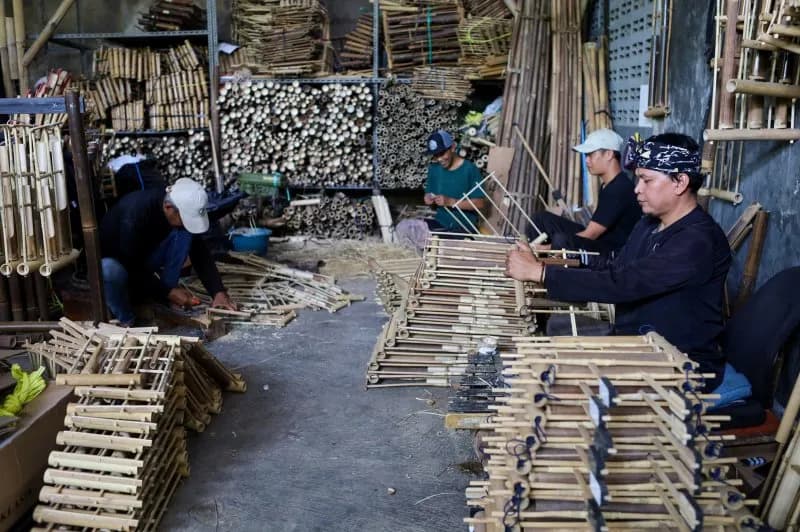
Today, the center involves about 600 performers, with Udjo's children, grandchildren and great-grandchildren continuing the musical legacy. The angklung itself consists of bamboo tubes suspended within a frame. When shaken, each instrument produces a distinct pitch, and played together they create harmonious melodies.
The instrument carries deep cultural roots. Traditionally, Sundanese communities used angklung in agricultural rituals honoring Dewi Sri, the rice goddess, invoking blessings for fertile land and bountiful harvests. In 2010, Indonesian angklung earned international recognition when UNESCO inscribed it on the Representative List of the Intangible Cultural Heritage of Humanity.
Visitors to Saung Angklung Udjo can experience bamboo craftsmanship, traditional dances and interactive musical performances, including opportunities to try playing the angklung themselves. The center also runs a training-of-trainers program, with participants from countries like Malaysia receiving certificates upon completion.
Beyond tourism, the center operates as a production hub. A team of seven to 10 craftsmen produces roughly 20 angklung instruments daily, though output varies with demand. Japan represents the largest export market, as angklung has been incorporated into school subjects there. Malaysia also receives strong demand. The center cultivates various bamboo species on its land, including at Udjo Ecoland where preparation and drying take place, though additional supplies are purchased to meet production needs.
Why it matters for hosts
Independent accommodation operators in Bandung can differentiate their guest experience by partnering with Saung Angklung Udjo for private tours or workshops. The center's training programs and interactive performances offer guests a hands-on cultural activity that goes beyond passive sightseeing, creating memorable stories travelers are likely to share. Promoting such authentic, locally rooted experiences can also help justify longer stays in Bandung rather than day trips from Jakarta.
This reporting draws from coverage by Bernama, which first published these details from Saung Angklung Udjo.
First reported by lifestyle.bernama.com.